Deep Drawing Parts:
Deep drawing is a stamping process that applies pressure to a metal flat blank through a die to deform it into an open hollow part (such as a cylinder, box, stepped shape, etc.). Its core is to flow and form the material under radial tensile stress and tangential compressive stress, while the thickness remains basically unchanged (non-thinning drawing) or partially thins (thinning drawing).
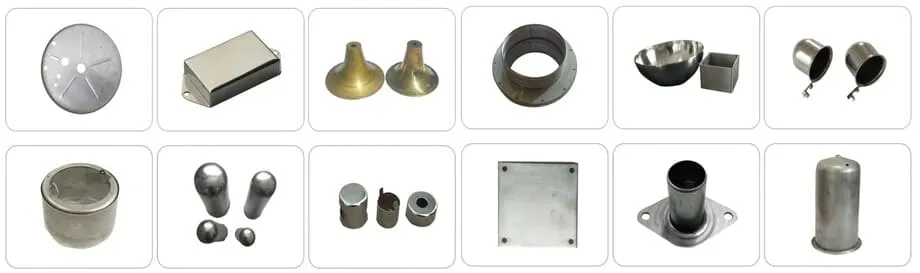
Processing Product Range:
- Simple Rotating Bodies: cylindrical parts (without flange/with flange), cup-shaped parts (such as battery shells, water cups);
- Complex Geometric Bodies: automobile fuel tanks, household cookware, electronic device housings (such as mobile phone middle frames);
- Special-Shaped Structures: box-shaped parts (lunch boxes), stepped parts (multi-level covers) and curved parts (spherical lampshades).
Core Features of Drawn Parts
1. High Shape Complexity: deep cavities, multiple curved surfaces and tiny features (such as precision electronic parts with a diameter of <1mm) can be formed;
2. Excellent Surface Quality: the surface is smooth after forming, and no secondary polishing is required;
3. High Material Utilization: compared with the cutting process, the scrap rate is reduced by 30%-50%;
4. Batch Cost Advantage: suitable for mass production, and the cost per piece is significantly reduced.
Key Points in the Processing Process
Anti-Wrinkling Control
- Excessive tangential compressive stress in the flange area will cause material instability and wrinkling;
- Solution: Use a blank holder and optimize the blank holder force
Anti-Crack Control:
- Dangerous sections of the barrel wall (at the corners of the die) are prone to cracking due to concentrated tensile stress;
- Countermeasures: Increase the radius of the corners of the punch and die (≥4 times the material thickness), and lubricate the die to reduce friction.
Springback Management:
- Compensate for elastic deformation through over-drawing or shaping processes.
Drawing Die Types and Applicable Scenarios
Single Process Die: The first drawing of simple cylindrical parts, simple structure and low cost.
Compound Die: Integrated blanking and drawing, high precision (±0.1mm), suitable for small and medium-sized parts (such as capacitor housing).
Progressive Die: Multi-station continuous stamping (trimming → drawing → punching), efficiency up to 800 pieces/hour, used for mass production of automotive parts.
Continuous Die: The robot transfers the blank, suitable for large and complex parts (such as automobile fuel tanks).
Material Range and Surface Treatment
● Common Materials:
- Low carbon steel (SPCC/SPCD), stainless steel (304/316), aluminum alloy (5052/6061) and copper alloy;
- The application of high-strength steel (HSS) is increasing, taking into account both lightweight and structural strength
● Surface Treatment:
- Corrosion Protection: mechanical polishing, galvanizing;
- Functionality: spraying, anodizing
Quality Inspection Standards
● Dimension Tolerance: diameter tolerance ±0.2mm, height tolerance ±0.5mm (IT10-IT12 grade);
● Surface Defects: no visible cracks, wrinkles, scratch depth ≤0.05mm;
● Mechanical Properties: hardness test, hole expansion test to verify ductility
● Batch Consistency: first piece inspection + sampling frequency ≥5%/batch.
Industry Applications and Trends
- Automobile Manufacturing: galvanized steel is mostly used for fuel tanks and motor housings;
- Consumer Electronics: metal middle frame radiator housings for mobile phones, with an accuracy requirement of ±0.05mm;
- Household Appliances: stainless steel cookers and washing machine inner drums, with food-grade surface treatment;
- Emerging Fields: new energy battery housings (high sealing), lightweight aerospace components (titanium alloy thinning and drawing).


